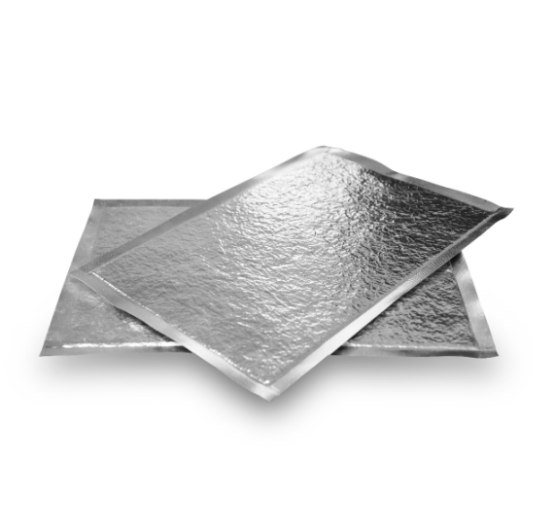
1 mm slim profile · 0.002 W/(m·K) thermal conductivity · no folded edges · custom shapes from supertech
The challenge
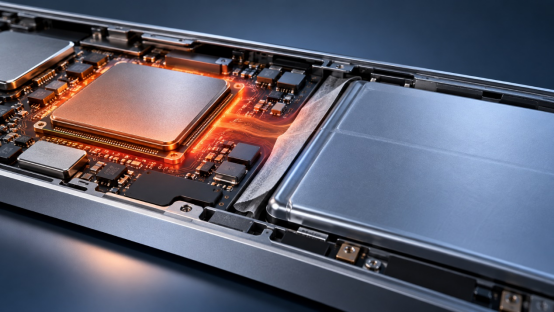
Inside compact consumer devices, the chip sits close to the battery, with barely any room for insulation. Devices need to stay slim, pack in more features and still keep heat under control. For tablet, laptop and wearable design teams, finding an insulation material is only part of the job. The real question is how to get the thermal performance you need in a tiny gap, while making assembly and long-term use work too.
Product overview
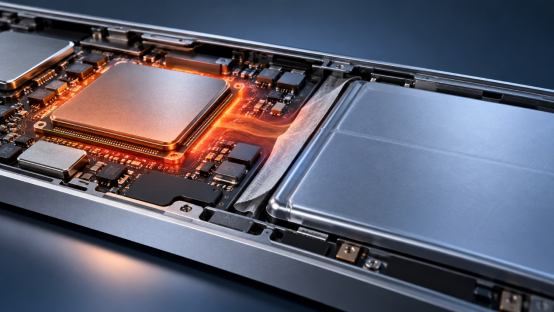
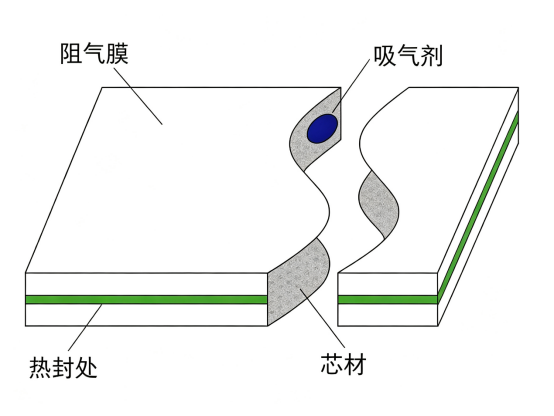
supertech ultra-thin VIP (Vacuum Insulation Panel) combines a porous core, an internal getter and a high-barrier composite film to create a vacuum insulation structure. The core provides mechanical support, the vacuum cuts gas-mediated heat transfer, and the getter absorbs residual gases to help maintain the vacuum over time.
Key specifications
| Parameter | Value |
| Minimum thickness | Down to 1 mm |
| Edge construction | No folded edges |
| Thermal conductivity λ | As low as 2.0 mW/(m·K) = 0.002 W/(m·K) |
| Core material | Porous open-cell material |
| Internal component | Getter (residual-gas absorber) |
| Barrier film | High-barrier composite film, preformed bottom shell |
| Flexibility | Bendable versions available |
| Customisation | Dimensions, thickness and shapes on request |
| Reliability data | Puncture resistance, heat-seal strength, leak rate, damp-heat ageing |
Why it fits tight consumer-electronics gaps
- Ultra-thin profile: down to 1 mm with no folded edges. This gives designers a size option to assess when insulation space is tight, while reducing the extra space taken up by edge structures.
- Low thermal conductivity: as low as 0.002 W/(m·K). All else being equal, lower conductivity means less heat passes through the material. When you cannot make the insulation thicker, that figure becomes the main selection basis.
- No folded edges plus flexible, bendable versions. Custom dimensions, thicknesses and shapes are available so the insulation can be matched to corners, curves, connectors and bracket positions instead of being squeezed into leftover space.
Note: the thermal-conductivity value is a material property, not a direct measure of how much cooler the finished device will run. Placement, edge design and heat-dissipation paths all affect the final result.
Typical application areas
Potential uses include chip areas in tablets and laptops, and the inside of wearables, to reduce heat exposure for batteries, displays and sensitive components. Three situations are worth evaluating:
- Heat source near the battery: place VIP along the local heat-transfer path between the processor/power component and the battery. Keep the heat source’s main cooling path open and check the battery’s own heat-release needs.
- Heat source near a display or sensitive component: use temperature mapping and structural analysis to see whether VIP can reduce heat transfer along that specific path. Simply covering more area is not necessarily the answer.
- Very little clearance: compare the slim VIP profile against other insulation options. Evaluate installed thermal performance, space requirement and assembly feasibility together.
These are application guidelines. Verify the actual result on a prototype.
Reliability for production
A sample that insulates well is just the starting point. VIP performance depends on the barrier structure and its ability to maintain vacuum. Assembly damage, environmental ageing and batch consistency all affect long-term use.
supertech ultra-thin VIP uses a preformed barrier-film bottom shell. Data on puncture resistance, heat-seal strength, leak-rate control and damp-heat ageing is available to support customer reliability assessment. Before selecting a material, check:
- Do the test conditions match the actual operating conditions?
- Is the assembly pressure within the specified limits?
- Could the mounting structure create sharp points of contact?
- Does the insulation still meet the target after long-term environmental testing?
About supertech
supertech is a listed company focused on developing and manufacturing vacuum insulation materials. Its ultra-thin VIP panels combine vacuum insulation, a slim profile and customisation for targeted thermal isolation in consumer electronics. Tight on space? A low-conductivity material to assess. Limited thickness? A 1 mm option. Complex geometry? Options to adapt the shape. Heading into production? Reliability data to check.
FAQ
Q: Will adding insulation definitely make the battery cooler?
A: Not necessarily. If nearby components are the main heat source reaching the battery, well-placed insulation may help. If the battery generates most of the heat itself, check that you are not blocking its cooling path. Verify the fit and performance through testing in the complete device.
Q: Can VIP panels replace thermal pads or heat sinks?
A: They usually do different jobs. Ultra-thin VIP reduces heat transfer along a specific path. Thermal pads and heat sinks help move heat away and release it. Choose each according to the thermal-design goal.
Q: What information is needed for a quotation / assessment?
A: Please share the heat source’s power dissipation, the components to protect, available clearance, operating temperatures, mounting method and allowable temperature limits. For a specific supertech ultra-thin VIP, also confirm edge clearances, bending limits and assembly loads.
Get in touch
If your device faces heat sources placed too close together with hardly any room for insulation, share your layout to explore where supertech ultra-thin VIP panels might fit. First identify the heat flow you need to interrupt, then validate the result on a prototype.