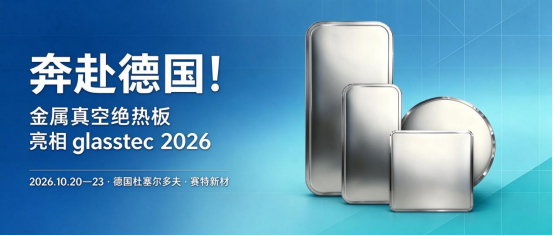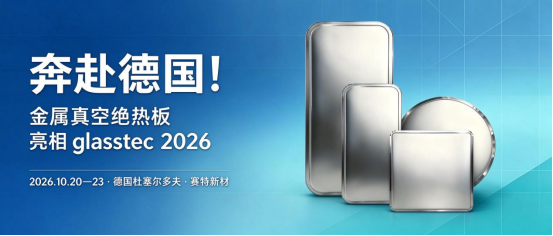
Following the nomination of our metal vacuum insulation boards at the BATIMAT building materials exhibition in France for the Innovation Award, we have once again set out for Europe, where we will now make our debut at one of the most prestigious international professional exhibitions in the global glass industry.
Our destination this time is glasstec—the bellwether of the global glass industry.
Some may ask: Why would one need a glass panel for a metal vacuum insulation panel?
Vacuum glass and vacuum insulation boards are, in essence, two different manifestations of the same technology. Both require vacuumization, both necessitate encapsulation, and both depend on their respective airtightness and leak rates.
Glasstec brings together the world’s foremost experts on “vacuum technology.”
glasstec 2026
Düsseldorf Exhibition Center, Germany
Date: October 20–23,2026
Booth: [H10 B85]
Connect with industry peers worldwide to discuss vacuum insulation solutions characterized by “ultra-thin profiles, non-combustibility, and a wide temperature range.”
01 Why glasstec?
Because we speak the same language: vacuum.
From low-carbon and energy efficiency to intelligent manufacturing, the glass industry is being redefined by a series of new challenges. As the industry turns its attention to “energy efficiency,” a practical issue has emerged—
Building energy consumption has never been confined to transparent areas.
On the curtain wall, the glass provides natural lighting and visual access;
Similarly, inter-window walls, inter-floor beams, column edges, parapets, and non-transparent panels are also undergoing continuous heat dissipation. As glass standards continue to improve, these “invisible areas” have instead become weak points in the building envelope.
The purpose of metal vacuum insulation panels (M-VIP) is precisely to address this second aspect of the challenge—providing the same level of vacuum insulation for the non-transparent portions of a building’s exterior envelope, beyond the vacuum glass.
Moreover, glass manufacturing is inherently a high-energy-consuming industry.
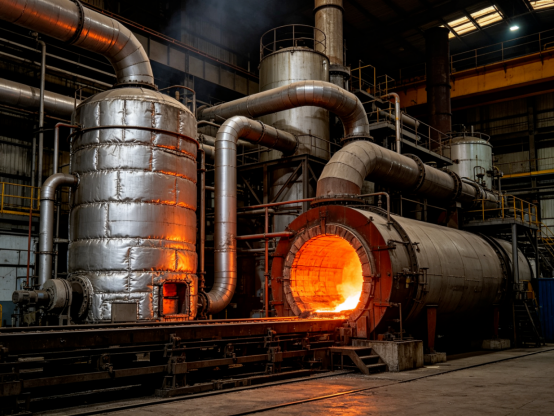
Fusion furnace, annealing furnace, tin bath, conveying channel…
The heat dissipation of every inch of the high-temperature housing incurs tangible costs—precisely the domain where M-VIP excels.
02 Transforming a vacuum into “a portable panel”
Traditionally, vacuum insulation requires a vacuum chamber.
Vacuum extraction, vacuum maintenance, and leak detection—once the vacuum is “locked” inside the equipment, it cannot be removed.
Metal vacuum insulation panels (M-VIP) transform a vacuum into a portable panel that can be directly attached to equipment.
It replaces conventional aluminum-plastic composite films with stainless steel films, extending its applicable temperature range to-196 °C to 800 °C; after vacuuming the panel, it undergoes welding and encapsulation, with the vacuum being carried by the panel itself—eliminating the need for an external vacuum chamber—allowing direct use under ambient pressure conditions.
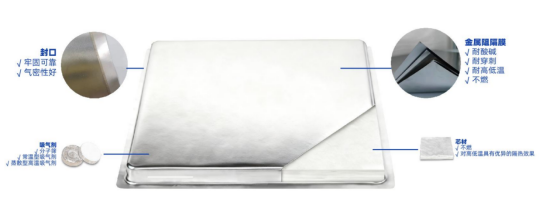
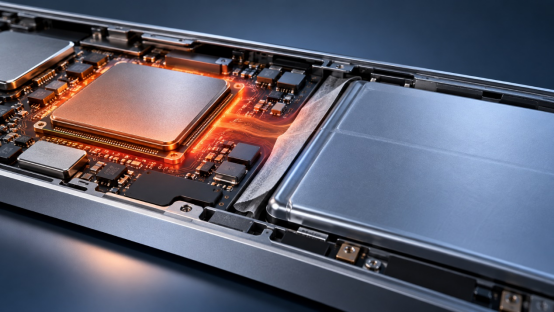
For the outer walls of equipment, pipelines, battery packs, furnace shells, and building walls in ambient pressure environments, M-VIP provides vacuum-grade thermal insulation without relying on external vacuum extraction, adsorption, or leak detection systems, while simultaneously offering the following benefits:
▶ Class A: Non-combustible; capable of withstanding pressure (compressive strength deformation <10% ≤0.5 MPa)
▶ Can be used as a load-bearing insulation layer
▶The stainless steel housing is puncture-resistant and offers excellent airtightness.
▶ thinner profile under equivalent thermal resistance, higher spatial efficiency, and reduced thickness and weight
03 The actual problem it solves: achieving vacuum insulation without a vacuum chamber.
Key data points:
- Thermal conductivity: ≤2 mW/(mK) at 25 °C, approximately 1/10 to 1/20 of that of polyurethane foam, aerogel felt, and mineral wool.
- Cryogenic test results: measured value of 0.6 mW/(mK) at an average temperature of-170 °C
- Applicable temperature range: -196 °C to 800 °C
- Thickness: 2–40 mm; surface density: approximately 2–5 kg/m² (for 10 mm thickness)
- Leakage rate: <10⁻¹⁰ Pam³/s (edge sealing width: 5–15 mm)
04 In which areas is it replacing traditional insulation?
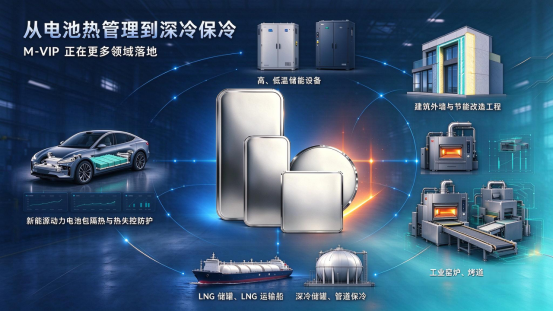
Building Exterior Wall and Energy Efficiency Renovation Project
✅LNG storage tanks, LNG carriers and cryogenic storage tanks, and pipeline insulation
✅ Thermal Insulation and Thermal Runaway Protection for New Energy Power Battery Packs
✅ High-temperature and low-temperature energy storage equipment
✅ Industrial kilns, baking ovens, and steam ovens
If you are seeking a thinner solution for non-transparent sections of your curtain wall; or if you need an attachable thermal insulation layer between the melting furnace and the quenching line;
Or, maybe you just want to feel it with your own hands—
How was a 10 mm thick plate capable of achieving a thermal conductivity of 2 mW/(m·K)? Both the sample and the complete test data are now available.
05 In-person meeting
glasstec 2026 · Exhibition Center, Düsseldorf, Germany
- Date: October 20–23,2026 (Daily 9:00–18:00)
- Booth: [H10 B85]
Backup title
Glasstec 2026 Countdown: Metal vacuum insulation panels set to debut in Germany