Coincé dans une guerre des prix sur les exportations de maisons conteneurs ? Des valeurs U de parois de niveau Maison Passive pourraient être votre solution.
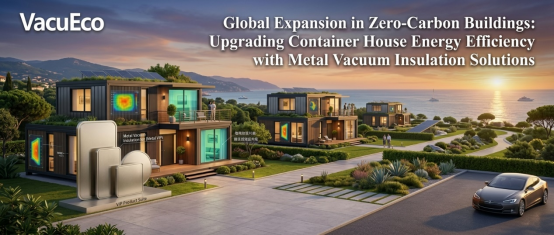
Les réglementations relatives à l’énergie dans le bâtiment se durcissent partout dans le monde. Pour les bâtiments modulaires et préfabriqués chinois destinés aux marchés haut de gamme d’Europe, des États-Unis et du Moyen-Orient, construire rapidement n’est qu’une partie de l’argument de vente. Les acheteurs souhaitent également maîtriser la consommation énergétique.
Vous souhaitez un argument de vente qui se démarque sans engendrer de coûts élevés liés aux certifications ? Pensez à une performance énergétique de niveau Maison Passive, avec une valeur U des parois extérieures ≤ 0,15~0,20 W/(m²·K). Cela attire l’attention des acheteurs.
Mais pour les équipes de conception de maisons conteneurs et de bâtiments préfabriqués, obtenir ce chiffre sur un rapport n’est que la moitié du travail. Les murs doivent tout de même fonctionner, et il faut encore offrir suffisamment d’espace intérieur.
Les mathématiques derrière le piège à paroi épaisse
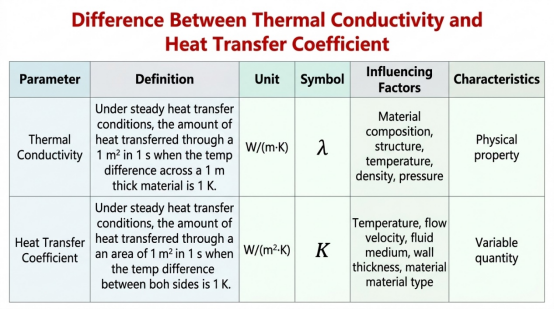
Différence entre la conductivité thermique et le coefficient de transfert de chaleur
| Paramètre | Définition | Unité | Symbole | Facteurs d'influence | Caractéristiques |
|---|---|---|---|---|---|
| Conductivité thermique | Dans des conditions de transfert de chaleur permanent, la quantité de chaleur transférée à travers 1 m² en 1 seconde lorsque la différence de température à travers un matériau d’une épaisseur de 1 m est de 1 K. | W/(m·K) | λ | Composition du matériau, structure, température, densité, pression | Propriété physique |
| Coefficient de transfert de chaleur | Dans des conditions de transfert de chaleur permanent, la quantité de chaleur transférée à travers une surface de 1 m² en 1 seconde lorsque la différence de température entre les deux faces est de 1 K. | W/(m²·K) | K | Température, vitesse d’écoulement, milieu fluide, épaisseur de paroi, type de matériau | Grandeur variable |
Voici les calculs de base : la résistance thermique de l’isolation R = d / λ, où d est l’épaisseur du matériau et λ la conductivité thermique. Le coefficient global de transfert de chaleur est K = 1 / ΣR, généralement appelé valeur U.
Pour offrir aux acheteurs une isolation de niveau Maison Passive avec un coefficient U ≈ 0,15 W/(m²·K), l’isolant doit fournir une résistance thermique globale R supérieure à 6,0 (m²·K)/W :
| Couche de matériau | Épaisseur d (m) | Conductivité thermique λ [W/(m·K)] | Résistance thermique R (m²·K/W) | Perméabilité à la vapeur d’eau μ [g/(m·h·Pa)] | Résistance à la perméance à la vapeur d’eau H [m²·h·Pa/g] |
|---|---|---|---|---|---|
| Panneau en polystyrène extrudé (XPS) | 0.06 | 0.003 | 1.818 | 0.000 06 | 333.33 |
| Mortier mixte | 0.02 | 0.87 | 0.022 9 | 0.000 097 5 | 205.13 |
| Mur en brique | 0.24 | 0.81 | 0.296 | 0.000 075 | 3 200 |
| Mortier de ciment | 0.02 | 0.93 | 0.021 5 | 0.000 12 | 166.67 |
Avec de la laine de roche conventionnelle ayant λ ≈ 0,040 W/(m·K), il faut d = Rλ = 6,00,040 = 0,24 m. Oui, cela correspond à 240 mm de laine de roche.
Les panneaux d’aérogel, avec une conductivité λ ≈ 0,020 W/(m·K), réduisent cette épaisseur de moitié, mais il reste tout de même environ 120 mm. À cela s’ajoutent un prix d’achat élevé et un risque d’effondrement structurel sous des températures élevées ou dans des conditions chaudes et humides.
Une couche d’isolation de 240 mm peut absorber près de 10 m² d’espace utilisable dans un ensemble modulaire de maison conteneur de 100 m². Cela représente une diminution de 10 % de la surface habitable, uniquement due à l’épaisseur des murs.
Et si le module volumineux dépasse les dimensions d’un conteneur ISO, les frais d’expédition peuvent augmenter plusieurs fois. Ouch.
Factures énergétiques élevées (OPEX), isolation humide
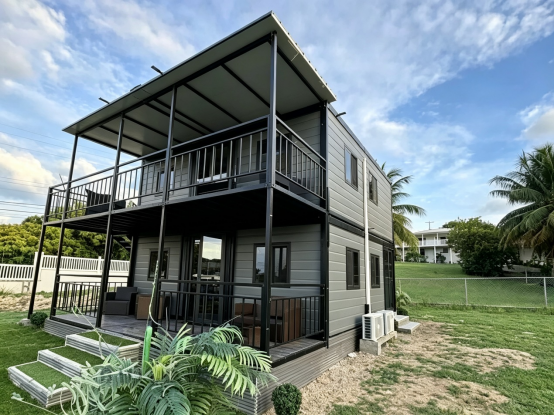
L’électricité est coûteuse, notamment en Europe, au Moyen-Orient et dans les pays insulaires. Les acheteurs ne se contentent plus de considérer le prix d’achat, mais prennent en compte les factures d’énergie qu’ils continueront à payer.
Du froid nordique à -30 °C à la chaleur du désert moyen-oriental dépassant 50 °C, de fortes différences de température entre l’intérieur et l’extérieur peuvent facilement provoquer de la condensation à l’intérieur des isolants fibreux poreux classiques.
À 20 °C, la conductivité thermique de l’eau est d’environ 0,6 W/(m·K), soit 25 fois celle de l’air. Dès que l’isolation devient humide, sa conductivité thermique réelle peut augmenter de manière exponentielle. C’est alors la fin de l’argument de vente lié aux économies d’énergie. La corrosion sous isolation (CUI) peut également affecter les ossatures en acier de faible épaisseur.
Des joints de panneaux mal conçus ainsi que des connexions au cadre métallique peuvent également créer de sérieux ponts thermiques dans les maisons conteneurs assemblées, entraînant de la condensation locale.
Panneaux d’isolation sous vide en métal minces (VAP) : changer l’équation
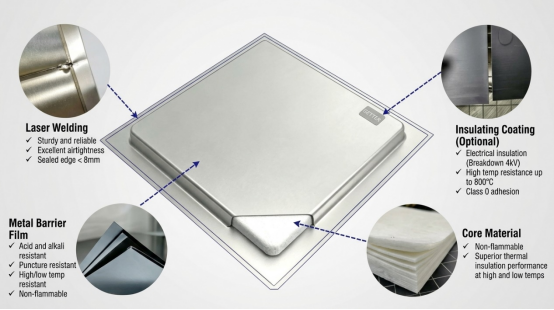
Soudure laser
-
Solide et fiable
-
Excellente étanchéité à l'air
-
Bord scellé < 8 mm
Film barrière métallique
-
Résistant aux acides et aux alcalis
-
Résistant aux perforations
-
Résistant aux hautes et basses températures
-
Non inflammable
Revêtement isolant (optionnel)
-
Isolation électrique (rupture diélectrique 4 kV)
-
Résistance aux hautes températures jusqu’à 800 °C
-
Adhérence de classe 0
Matériau de base
-
Non inflammable
-
Performances d’isolation thermique supérieures à haute et basse température
Vous souhaitez une isolation de niveau Maison Passive sans avoir à insérer 20 cm d’isolant dans les murs ? Il vous faut alors une conductivité thermique λ bien plus faible.
C’est là qu’intervient la physique du vide. En plaçant le cœur sous un vide poussé, on élimine la conduction et la convection des gaz.
Prenez les panneaux d’isolation métalliques sous vide haute température VAP de Super Tech Advanced Material, une solution à enveloppe métallique pour les applications industrielles et bâtimentaires. La conductivité thermique peut rester inférieure ou égale à 0,0018 W/(m·K) sur toute la plage de températures -196 °C à 800 °C.
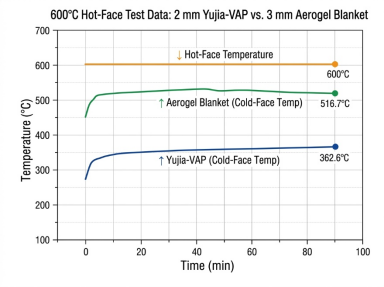
Données du test face chaude à 600 °C : 2 mm Yujia-VAP contre 3 mm couverture d’aérogel
Introduisez cela dans la formule. Pour R = 6,0 (m²·K)/W, l’épaisseur requise du panneau d’isolation sous vide en métal est simplement d = 6,0*0,0018 = 0,0108 m ≈ 11 mm.
Seulement 15 à 20 mm de panneaux d’isolation sous vide en métal résistant à haute température peuvent égaler les performances d’isolation de 240 mm de laine de roche conventionnelle !
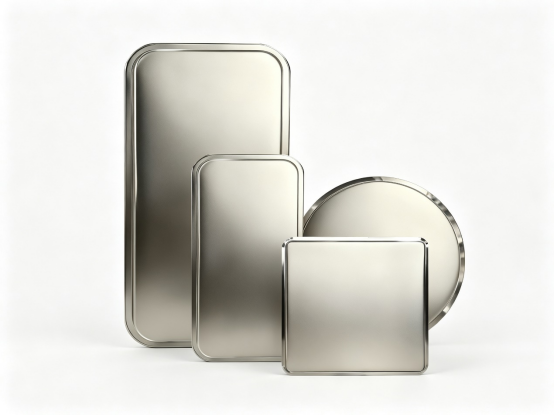
Pour les projets premium de maisons conteneurs, cela transforme un casse-tête d’isolation en trois atouts majeurs :
Une bonne isolation n’exige pas forcément des murs épais.
Oubliez d’empiler des couches d’épaisseur pour augmenter la résistance thermique. Une structure sous vide en métal de 5 à 40 mm peut atteindre un coefficient U ≤ 0,15 W/(m²·K), libérer de l’espace qui disparaîtrait autrement dans les murs et maintenir les modules dans les dimensions autorisées pour l’expédition. Plus d’espace à l’intérieur, meilleure utilisation de la capacité des conteneurs.
Conçu pour supporter les variations de température. Conçu pour protéger la structure.
Une plage de fonctionnement ambiante de -40 °C à 90 °C couvre des projets dans des climats extrêmes, allant de la chaleur supérieure à 45 °C en Arabie Saoudite jusqu’au froid de -40 °C au Canada.
Même à une température moyenne de -170 °C, le panneau d’isolation sous vide en métal (VIP) maintient une conductivité thermique de 0,0006 W/(m·K).
La coque en acier inoxydable SUS304 de 0,1 mm est entièrement soudée au laser, avec un taux de fuite < 10⁻¹⁰ Pa·m³/s, scellant le cœur dans un vide exempt d’air et d’humidité. Même face à de fortes variations de température et à une pression d’humidité intense, la conductivité thermique demeure stable. Aucun effondrement lié à l’humidité de la résistance thermique, avec une protection contre la CUI tout au long de la durée de vie.
Isolation continue, tout autour du bâtiment.
Les fuites de chaleur par les joints des panneaux constituent un problème récurrent dans les maisons conteneurs. Commencez par des joints de bord ultra-fins dès la phase de préfabrication, puis utilisez des joints chevauchants et emboîtés ainsi que des bandes flexibles étroitement ajustées, dotées d’une haute résistance thermique sur site. Ainsi, la transmission thermique linéaire au niveau des bords (valeur Ψ) reste très faible et l’on obtient une couche d’isolation passive continue et enveloppante.
Ce que VAP apporte aux exportations de maisons conteneurs
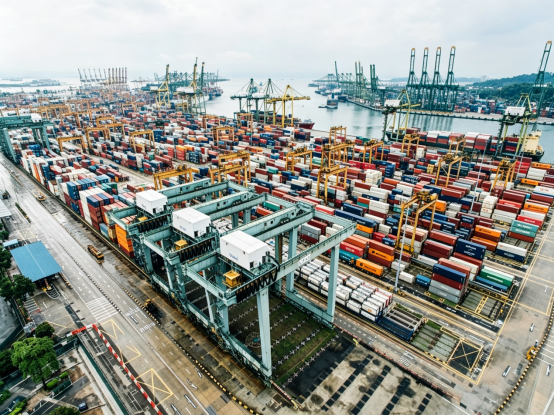
Le marché évolue : on ne vend plus seulement des boîtes métalliques, mais des bâtiments de qualité. L’utilisation énergétique de niveau Maison Passive devient un véritable moyen de se distinguer de la concurrence.
Les panneaux d’isolation sous vide en métal VAP de Super Tech Advanced Material, conçus pour résister à des températures élevées et aux chocs importants, offrent aux usines de maisons conteneurs une solution technique pratique : tirer parti de leurs performances thermiques exceptionnelles pour dépasser les contraintes d’espace.
Panneaux d’isolation sous vide en métal VAP pour hautes températures : les spécifications
| Paramètre | Valeur |
|---|---|
| Conductivité thermique | ≤0,0018 W/(m·K) |
| Température de fonctionnement recommandée | -196°C à 800°C |
| Résistance à la compression (<10%) | ≤0,5 MPa |
| Masse volumique apparente | 250 à 420 kg/m³ |
| Masse surfacique (10 mm) | 2 à 5 kg/m² |
| Taux de fuite | <10⁻¹⁰Pa.m³/s |
| Taille maximale | 500×1000 mm |
| Taille minimale | 100×100 mm |
| Plage d'épaisseur | 2 à 40 mm |
| Largeur du joint de bord | 5 à 15 mm |
| Ininflammabilité de classe A | — |
| Besoin d’autres tailles ou formes ? | Des options sur mesure sont disponibles. |
Les murs extérieurs restent minces, la surface utile demeure entièrement disponible, et la résistance thermique résiste aux conditions extrêmes de froid comme de chaleur.
Pour les fabricants de maisons conteneurs, cela ouvre la voie à des projets touristiques haut de gamme à l’étranger, à des hébergements exigeants sur les sites miniers et à des appels d’offres pour des bâtiments à zéro carbone. L’argument est simple : des économies d’énergie significatives et des coûts d’exploitation faibles pendant des décennies, offrant aux acheteurs une raison de payer davantage.
Échangeons nos idées : avez-vous recours à une faible consommation d’énergie ou à une meilleure isolation pour vous démarquer sur un projet de maison conteneur ou de module export ? Laissez un commentaire sur les calculs thermiques des parois selon les différents climats, ou sur la manière dont vous choisissez une isolation plus fine.