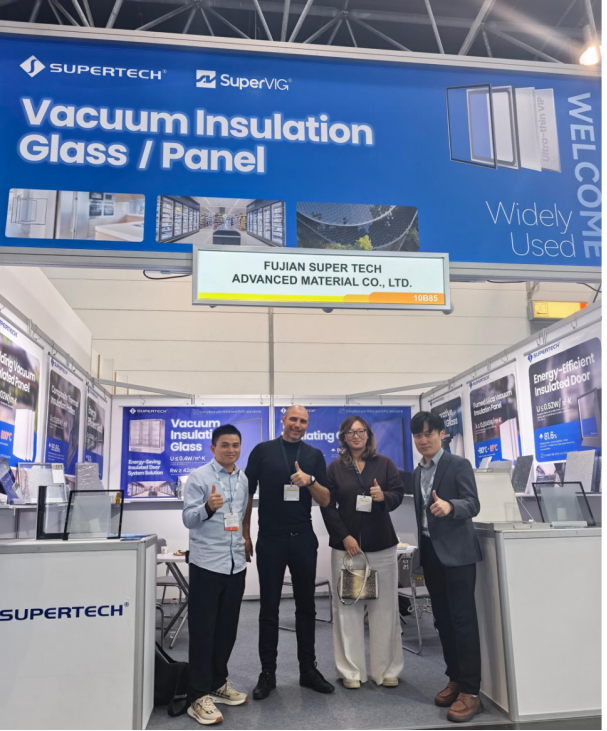
On October 23, glasstec 2026 came to a successful conclusion in Düsseldorf, Germany.
Across the four exhibition days, the conversations at booth H10 B85 were concrete and hands-on: some visitors leaned in to examine the edge seals, others pressed the panel surface, and some sat down with drawings to discuss how spandrel connections should be detailed.
Looking back on these exchanges, we saw that what visitors asked was not just “is this panel good?” but “how does this panel get used in a real project?” These questions can be answered by following a panel’s journey into a construction site, step by step.
1. Space First: 2–40 mm, Every Millimetre Counts
The first question any panel faces on site is always: will it fit?
The thickness budget for spandrel connections is limited, and kiln shells need to be made even thinner. The tighter the space, the finer the trade-offs. Yujia® metal vacuum insulation panels (M-VIP) cover a thickness range of 2–40 mm — an order of magnitude thinner than traditional materials at equivalent thermal resistance — so you can select the right thickness for the available space.
Fitting is only the first step. Next comes the question: once it is thin, does the performance stay stable?
2. Stable Performance: -253℃ to 800℃, Stable Once Installed
Making a panel thinner must never come at the cost of performance, and that performance must hold not only at the factory gate.
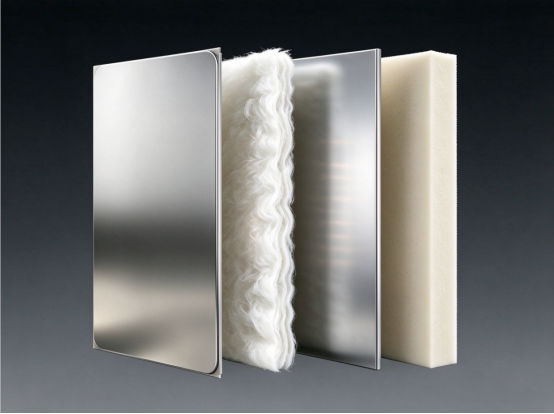
Yujia® replaces the traditional aluminum laminate film with a stainless steel film, extending vacuum insulation from cryogenic to high-temperature service, covering -253℃ to 800℃ and suiting LNG, battery packs, kilns and other scenarios. The most intuitive proof of reliability often lies not in the datasheet, but in the hands and eyes.
3. Surface Details: Edge Sealing and Panel Face Are Part of Quality
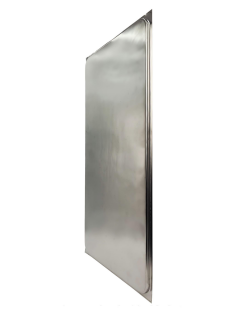
Many visitors, upon receiving samples, immediately examined the edge sealing and pressed the panel surface. Although non-transparent sections are “out of sight,” whether the edge seal is smooth and the panel face is regular is part of engineering quality.
4. Installation Is the Final Step: A-class Non-combustible, Usable as Load-bearing Insulation
Once a panel passes the visual check, the most practical hurdle remains: how exactly is this panel installed? How the connection is detailed, how it is installed on site, and how the fire rating is matched all come to light at this step.
Yujia® is A-class non-combustible, with deformation of less than 10% under 0.5 MPa pressure, so it can be used as a load-bearing insulation layer; at 10 mm thickness, the surface density is approx. 2–5 kg/m², making handling and wall installation lighter. For specific connection details, our technical team will follow up based on your operating conditions.
5. Four Questions, Converging at the Construction Site
From fitting, to stability, to appearance, to installation — these four questions are interlinked, and all converge on two words: construction workmanship.
The needs we gathered on thickness, performance, appearance and installation will provide important reference for our product innovation. We will organize the operating conditions and needs recorded on site and hand them to our technical team for evaluation, moving our products from “usable” to “easy to use.”
6. We Welcome Further Discussion
The exhibition is over, but the problems in engineering do not stop.
If your project is considering spandrel walls, non-transparent curtain wall panels, kiln shells, or insulation solutions for LNG and battery pack scenarios, please share your construction conditions and challenges with us.
Thank you for meeting us — we look forward to meeting again!